A Brief History of Film
Part Eight: The Bigger, the Better – Hollywood Goes Wide
by Fr. John Wykes, OMV
The appearance of television had a huge impact on the Hollywood movie industry. Suddenly, Americans had access to visual entertainment in their own homes. Cartoons? They could be viewed on TV. Movie news reels? They were easily supplanted by well-written and highly-crafted TV news programs. Movies? They could be viewed on the small screen as well (as long as the networks got the rights to show them). Suddenly movie theaters were becoming obsolete. Why go out to a movie theater and pay money when one could stay home and watch TV for free?
Hollywood was at war with television – and had to bolster its armaments if it wanted to survive.
The big movie studios had two powerful weapons in their pockets. One was color – something that TVs in the 1950s could not offer and something that movies could offer in a lush and vibrant manner. Another was size. While having visual moving images in the family living room was quite the revolution, the screen still looked pretty small and could not compete with the magic of the much-larger silver screen.
So Hollywood went big – big time. This meant larger cameras and larger formats with a larger aspect ratio.
“Aspect ratio” is the overall shape of the film frame. The shape is expressed as a proportion. TVs (as well as movies) typically had an aspect ratio of 4:3. That is, four units of measurement wide by three units high. Though technically a rectangle, this particular aspect ratio took on the appearance of a square, or something very close to a square. Thus, old movies and old TV shows had what looked like a “square” frame. 4:3.
Hollywood decided to create entirely new and very wide formats. This would be costly. This meant that the extra wide film had to be manufactured from scratch, along with the brand-new film cameras that could handle that format, and brand-new movie projectors and screens in every theater that also featured the new “shape.”
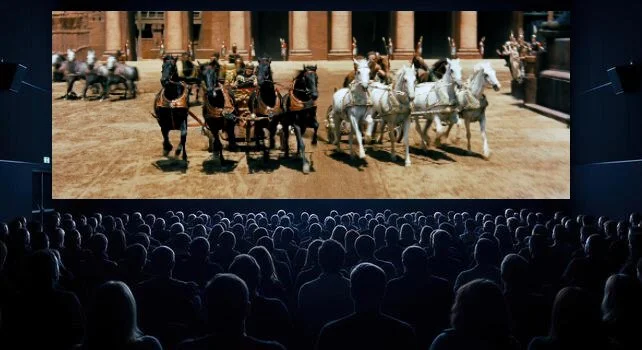
The most famous wide screen format was 70mm. Film formats are named by their width in millimeters, so the standard (sort of square) 35mm movie film was thirty-five millimeters wide. The new 70 mm was twice the width of the old format. This not only allowed for a wider screen but also for an extra-sharp picture (the larger the format, the smaller the film grains appeared to the naked eye, and the more detail could be captured. This is why a professional film looked sharp and a Super 8 home movie looked “grainy.”).
Sometimes special anamorphic lenses were used to “squeeze” an image onto a smaller film format, with a similar lens used to “unsqueeze” the image when projected. This process was used for Ben-Hur (1959), which was filmed using MGM’s 65 mm. format and a 2.76:1 aspect ratio.
Ben-Hur made lots of money and gobbled up a record number of Oscars at the Academy Awards. This only validated Hollywood’s decision and wide-screen epics became the mainstay of the movie industry. Many 70mm epics followed, including Exodus (1960), West Side Story (1961), It’s a Mad, Mad, Mad, Mad World (1963), My Fair Lady (1964), and The Sound of Music (1965). It is a tribute to the skilled directors and cinematographers of the era, as well as to the lush and sharp wide screen formats, that these films look as stunning today as when they were first released.
Even the Soviets got in on the game. Their bloated but still impressive seven-hour-long movie version of War and Peace (1966-1967) was shot on Sovscope 70 mm and boasted huge battle scenes with over 13,000 extras. Not surprisingly, stressed-out director Sergei Bondarchuk, who also starred in the movie, suffered two major heart attacks during shooting.
Arguably one of the most beautiful films ever made was Lawrence of Arabia (1962). Shot on the massive Super Panavision 70 format by cinematographer Freddie Young and directed by David Lean, the film involved hauling out large cameras and other massive equipment into the Jordanian desert. The breathtaking result stunned audiences of the time and still looks impressive even today. New 4K and 8K digital transfers bring out details that were already present in the original film negative.
As profitable as this era was for Hollywood, newer and younger voices would quickly take over in the late 1960’s and early 70’s. Sunny musicals and Biblical epics would be supplanted by gritty realism and brutal violence. The New Hollywood movement will be the subject of our next article.
Note: After two weeks, this article will be archived under “A Brief History of Film” which can be located under “Articles, Essays, Blogs, and More” from the main menu.