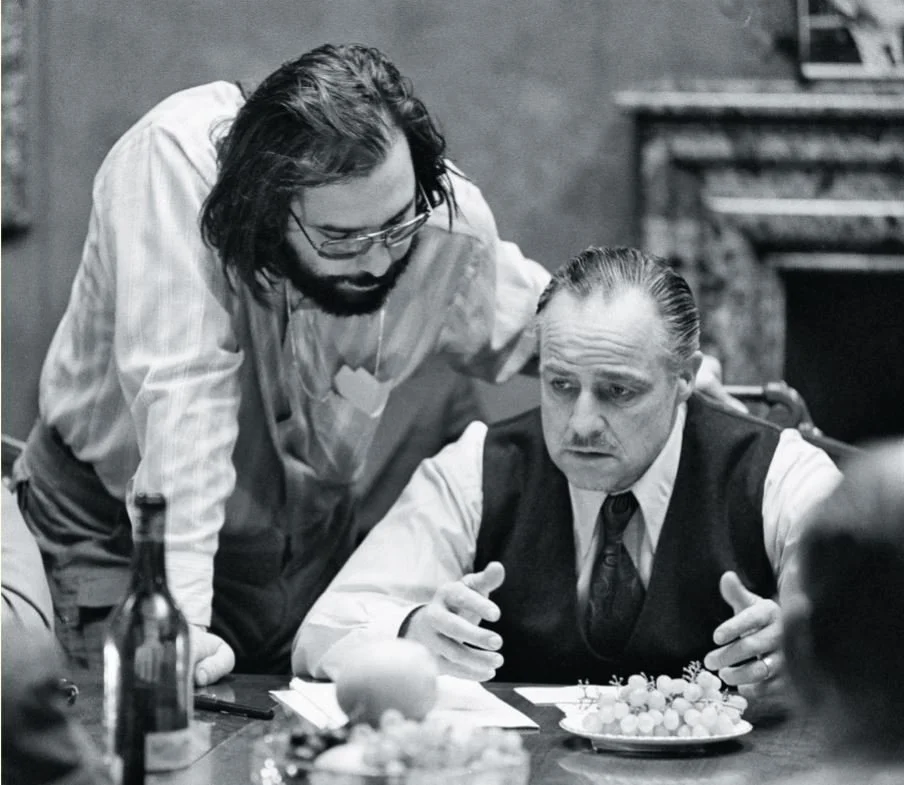
Francis Ford Coppola directs Marlon Brando.
The Godfather (1972)
A Brief History of Film
Part Nine: “It’s strictly business…” – The Rise of New Hollywood
by Fr. John Wykes, OMV
Every generation can point to a shared socio-cultural moment when innocence was lost. For Baby Boomers, born in the affluent post-war era of Howdy Doody and Elvis, that moment came in November of 1963. For an entire agonizing weekend, the country and the world were glued to their television sets, watching the almost unbelievable images coming in from Dallas, Texas. A Howdy Doody view of the world was coming to an end – and right quick.
The Kennedy assassination and the subsequent on-air murder of his accused killer had serious cultural repercussions in the following years. Add to this a Vietnam War that was spinning out of control, social unrest, student uprisings, and the meteoric increase in drug use, and you have a seismic cultural shift that reached everywhere – including Hollywood.
The movie industry got rid of its Hays Code in 1968, replacing it with a voluntary rating system overseen by the MPAA (Motion Picture Association of America). A radical cinematic permissiveness was now possible and the time was ripe for a new generation of filmmakers to make their mark – oftentimes with realism, violence, and sexually explicit material.
These young men adored the likes of Godard, Truffaut, Kurosawa, and Welles – falling in love with their movies in film school. Now they were ready to graduate and move out on their own – and they were not about to make another “South Pacific.” Their names would soon become famous: Dennis Hopper, Roger Corman, Francis Ford Coppola, Martin Scorsese, and George Lucas, among others.
Dennis Hopper’s Easy Rider (1969) touched a chord with the drugged-soaked hippie generation. When the independent flick ended up earning 150 times its tiny budget, Hollywood took notice. This author (Fr. John Wykes) once talked to a man who was in the room when it happened. “It” was a meeting of all the high-powered musical producing giants at a major studio. They were gathered together, thanked for their great work in past years, and then fired.
What followed was a series of classic New Hollywood films – a few excellent, some fair, others horrible, but most very much imbued with steaming sexuality, violence, and progressive counter-culture philosophy.
Few of the New Hollywood filmmakers ruled the early 1970s as did Francis Ford Coppola, whose The Godfather (1972) and The Godfather II (1974) broke box office records and ended up winning Academy Awards for Best Picture in their respective years. Coppola quickly produced The Conversation (1974) in between the two Godfathers. It was nominated for a Best Picture Oscar and is still considered a New Hollywood classic.
Martin Scorsese took the street violence he witnessed in Queens as a boy and brought it to his violent Mean Streets (1973) and the shockingly blood-soaked Taxi Driver (1976). Later on, his films became more refined – though still violent.
Take Hollywood’s love for star-studded spectacles and combine it with the early-70s penchant for dreary, violent content, and what do you get? The strangest and most unique of all film genres – the disaster film.
Really only one name dominated the disaster film genre, and that name was Irwin Allen. A skilled writer, director, and producer, Allen managed to attract some of the biggest names in Hollywood to sets where their characters got drenched, soaked, burned, and otherwise victimized by whatever disaster dominated the scenario. Diverse stars such as Gene Hackman, Jack Albertson, Shelley Winters, and Roddy McDowall were thrown into an upside-down cruise ship in The Poseidon Adventure (1972) while William Holden, Jennifer Jones, Fred Astaire, Faye Dunaway, and Richard Chamberlain were trapped inside a burning skyscraper in The Towering Inferno (1974).
Science fiction of the era was also decidedly dark. Planet of the Apes (1968) featured an astronaut’s visit to an “upside down” world – and his confrontation with humanity’s self-destruction. Soylent Green (1973) was a socio-economic nightmare about a bizarre nutritional supplement of the future – and its scary origins. And Logan’s Run (1976) presented a society in which people underwent mandatory annihilation at the age of thirty.
Joining in on the dystopian fun was a young man named George Lucas. He made THX-1138 4EB (1967) while still at USC. The post-apocalyptic student film received a lot of positive attention. Later on, Lucas had the rare opportunity to re-make it professionally as THX-1138 (1971) with Robert Duvall playing the title role. “THX Sound,” by the way, a common feature of later films, had no technical significance to the name but was a homage to Lucas’ first opus.
Films of the early 70s were soaked in darkness. But Lucas and friend Steven Spielberg had other plans. Though of the same generation as many other New Hollywood directors, they had a different creative bent. They leaned not towards violent anti-establishment cinema, but towards the light-hearted and fun sci-fi movies and adventure serials they watched as boys back in the 1950s. They were itching to make films that would entertain, not preach. The Lucas-Spielberg revolution that quickly tore down New Hollywood cinema will be the subject of our next article.
Note: After two weeks, this article will be archived under “A Brief History of Film” which can be located under “Articles, Essays, Blogs, and More” from the main menu.