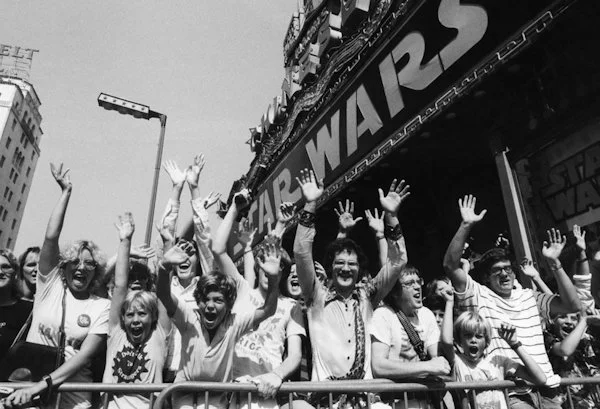
Star Wars fans in 1977.
A Brief History of Film
Part Ten: Lucas Destroys the Death Star – and New Hollywood as Well
by Fr. John Wykes, OMV
Perhaps no event marked the early 1970’s victory of liberal New Hollywood’s revolution more than the special Oscar for Charles Chaplin. Back in the 1950s, Chaplin, a British native who had never sought U.S. citizenship, journeyed to England for the premiere of his new film, Limelight (1952). J. Edgar Hoover, who had been after him for years (the FBI file on Chaplin’s alleged Communist-sympathizing activities numbered nearly 2,000 pages), saw a golden opportunity and (through the attorney general) rescinded the director’s re-entry permit the moment he left U.S. waters. Chaplin, who had helped lay the foundations of Hollywood, had been thrown out of the country. He and his wife Oona set up permanent residence at a chateau in Switzerland.
By the early 1970s, the climate had changed dramatically, and now Hollywood invited Chaplin back to receive a Lifetime Achievement Academy Award. Now in his early 80s, Chaplin expressed great reservations, fearing he would be arrested as soon as he set foot on U.S. soil. The Academy as well as the Nixon administration assured the aging director that this would not happen. Chaplin showed up to receive his award and the progressive Hollywood elite greeted him with the longest standing ovation in Oscar history – twelve minutes long.
The ovation was well-deserved, as Chaplin was one of the greatest comic geniuses Hollywood ever knew. It was also a sign that New Hollywood’s revolution was complete.
Or was it?
Chaplin’s tears of joy were barely dry when American Graffiti (1973) began principal photography. A far cry from the violent and dark films of the era, George Lucas’ opus was a love letter to the teen culture of the 1950s. It proved to be very popular, as was Steven Spielberg’s film adaptation of Jaws two years later. This should have been a warning sign to Hollywood that something was about to change – dramatically so.
After American Graffiti, Lucas had the pull for his dream project – a space adventure that would harken back to the fun sci-fi serials of the 1950s. Called The Star Wars (later shortened to Star Wars) the idea owed a lot to Frank Herbert (who had authored the popular Dune novels) and Akira Kurosawa (whose plot for The Hidden Fortress {1958} was largely duplicated by Lucas, as Lucas readily admits).
This was a daring move by the young director. The tenor of the times seemed to call for violent, dark films immersed in existential angst. Fun sci-fi serials of the 1950s seemed dated and shallow by comparison.
But few executives in Hollywood realized the true tenor of the times. The American public, weighed down by the civil unrest and multiple, high-profile assassinations of the 1960s, were now even more despondent over what the early 1970s had to offer, including the Manson murders, the Watergate scandal, the terrorist nightmare at the Munich Olympics, the never-ending Vietnam War, the energy crisis, and the urban decay of America’s cities. People surrounded by misery were now sick of seeing even more misery at the movies. They had had their fill of gangster flicks and disaster films. They were looking for something different. Even though they didn’t know it at the time, they were looking for Star Wars.
Disney, Universal, and United Artists all said no to the project, deeming it too strange and too risky. 20th Century Fox, happy with Lucas’ American Graffiti, decided to take a chance.
Boasting new, highly-advanced motion control visual effects of the new Industrial Light and Magic, and a loud, expansive John Williams score performed by the London Symphony Orchestra, Star Wars was released upon an unsuspecting public in 1977. Even before the age of social media, word of mouth was immediate and frantic. This was a film with amazing effects, beautiful music, and memorable characters. Best of all (and most astonishing of all), the movie was a clear battle of good vs evil and even had a happy ending.
Some critics were aghast. Wasn’t the New Hollywood about urban plight and exploring the gritty, violent undercurrents of a broken humanity? And now we have a silly movie like Star Wars? How could anyone take such a film seriously? Two young critics from Chicago, Roger Ebert and Gene Siskel, broke ranks and praised the film as something refreshing and different – escapist entertainment that the American public sorely needed.
Much to the astonishment of everyone (most especially the cast), Star Wars took off like no film had before, amassing such a huge amount of money that its first run in theaters lasted for over a year. When it officially became the most profitable film in the history of cinema, Hollywood switched gears as quickly as possible.
It takes two calendar years to make a feature film. Considering this, it is not surprising that 1979 (two years after Star Wars) became a bonanza year for science fiction and spectacular visual effects. Disney, whose animations had experienced a downturn, quickly turned out The Black Hole. 20th Century Fox released Alien. United Artists, whose treasure remained the highly-popular Bond films, sent 007 into earth orbit with Moonraker. And Universal released Buck Rogers in the 25th Century. All were released in 1979.
Paramount had acquired the old Star Trek television series when it bought Desilu. Always unpopular during its initial run on NBC, Star Trek had acquired a unique and loyal following in syndication, proving to be so popular that Paramount (in the mid-1970s) planned a new television show to be called Star Trek – Phase II. Scripts were written, sets were built, and the cast was assembled.
And then came Star Wars.
Seeing dollar signs, Paramount decided quickly on a bizarre gamble – to turn this cult TV series into a multi-million-dollar movie. This was totally unprecedented. The newly-constructed Phase II sets were destroyed. Costumes were re-designed. Leonard Nimoy, who had declined to appear in Phase II, was now coaxed back to re-join the original cast as Mr. Spock. Highly-successful Robert Wise became the director. John Dykstra, the man behind the effects for Star Wars, and Douglas Trumbull, the man behind the effects for Steven Spielberg’s Close Encounters of the Third Kind (1977), ended up working together on the new Trek film, producing an historic number of visual effects shots that hold up well to this day. Star Trek – The Motion Picture was rushed into release in 1979, underperforming domestically but doing well internationally and (later) on home video.
Spielberg had already made his mark with Jaws (1975) and Close Encounters (1977). Now he would team up with friend George Lucas to make the highly successful Raiders of the Lost Ark (1981) and its sequels. Lucas continued his Star Wars franchise with The Empire Strikes Back (1980) and Return of the Jedi (1983), both highly successful. Spielberg returned to alien adventures with his E.T. The Extra Terrestrial (1982) which raked in an astonishing $619 million dollars worldwide with its initial release. Making a grand total of $797 million dollars when including subsequent re-releases, E.T. was the highest grossing film of all time – keeping that title for eleven years.
Hollywood had changed. Both Lucas and Spielberg seemed to be unstoppable. By 1990, the pair was responsible for eight of the ten top-grossing films of all time. And yet, other filmmakers were on the rise – both new and old. The rise of a new foreign cinema, the rediscovery of old cinema, and the VHS videotape explosion will be covered in our next article.
Note: After two weeks, this article will be archived under “A Brief History of Film” which can be located under “Articles, Essays, Blogs, and More” from the main menu.