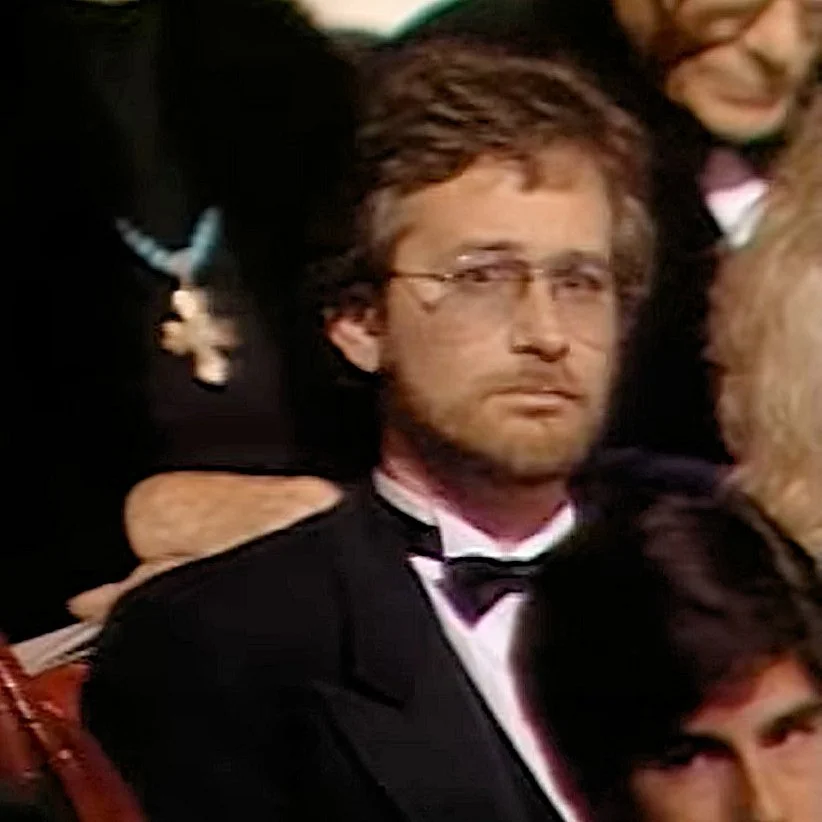
Steven Spielberg looks tense as he waits for the Best Picture to be announced. Oscar Night, 1983.
A Brief History of Film
Part Eleven: The Rise of the Brits and the Rise of VHS
by Fr. John Wykes, OMV
No one was more tense than Steven Spielberg.
It was Oscar Night of 1983. His film, E.T. The Extra Terrestrial (1982) was the all-time box office champ. It had captured four awards that evening, including one for John Williams and his wonderful score. Now Spielberg was up for Best Director and Best Picture. His face was tense and grave. More than anything, he wanted to be taken seriously as a great filmmaker.
Memories of the previous year’s Oscars were still fresh. Screenwriter Colin Welland had famously exclaimed, “The British are coming!” when picking up his award for Best Screenplay for Chariots of Fire (1981). It was seen more like a joke – until later that evening when Chariots won Best Picture despite having not won any other major acting or directing award. Some in the audience gasped in astonishment. It was a shocker.
Now, moving forward to 1983, there was one award left. Spielberg had already been humiliated once – losing his directing Oscar to Richard Attenborough for Gandhi (1982). Would E.T. win Best Picture? The answer was “no.” Gandhi was announced, and Richard Attenborough walked up to collect another Oscar. Hollywood had lost to the British for the second year in a row. To paraphrase the Emperor from Return of the Jedi (1983), now Spielberg’s (and Hollywood’s) humiliation was complete.
Sydney Pollack also lost that night. His Tootsie (1982) had won some impressive awards but lost the big ones. Thus it is not surprising that both Spielberg and Pollack would attempt, in the ensuing years, to beat the Academy at its own game. If the Oscars suddenly took a liking to historic dramas, then historic dramas they would make.
Pollack presented his Out of Africa in 1985 and it won Best Picture and Best Director. Spielberg made Empire of the Sun in 1987. It was nominated for several technical Oscars and lost all of them. Initially a box office failure, Empire made its money back through home video.
This was not the first time Spielberg met with disappointment. His 1941 (1979) cost $35 million to make and was a flop domestically (but did well enough internationally to make back a modest profit). After finishing up his Star Wars trilogy, Spielberg’s friend George Lucas made Howard the Duck (1986). It was a box office disaster and has been hailed as one of the worst films ever made.
Even Francis Ford Coppola began to stumble. His Apocalypse Now (1979) had a troubled production history and received very mixed reviews when first released (though reappraisals in recent years laud it as a great film). One From the Heart (1982) was Coppola’s failed attempt to make a musical. It was a critical disaster and bombed at the box office.
Say the word “disaster” and few films rise to the apocalyptic level of Heaven’s Gate (1980). Michael Cimino had been given a blank check due to the success of the Deer Hunter (1978). Now the Oscar-winning director set out to make a sweeping historic epic about an obscure land dispute in 19th Century Wyoming. Shooting went way over schedule and expenses were outlandishly reckless, but no one had the courage to say “no.” In the end, $40 million was spent, making it the most expensive film ever made until that time. The first version was over five hours long and Cimino was forced to cut two hours to make it releasable. When it premiered, the critical response was so overwhelmingly negative that United Artists pulled it from theaters and issued an unusual public apology as Cimino recut the film. It was released again and was such a disaster that it almost destroyed United Artists (this, in turn, prompted the sale of United Artists to MGM). Steven Bach’s Final Cut is well worth the read and is an often-humorous account of this cinematic nightmare. Though many critics have called it a misunderstood masterpiece, this author (Fr. John Wykes, OMV) forced himself to watch Heaven’s Gate and found the experience almost unbearable.
On a humorous sidebar note, this author was attending a Catholic Media Conference in the early 2000s when we were asked, for fun, to list our favorite and least favorite films of all time. Heaven’s Gate ended up being mentioned by me and by the Catholic Academy’s president. But the president called it the greatest film of all time while I called it the worst film of all time.
The 1980s was the era of VHS videotape. Beating out Betamax in the format wars, VHS cassettes allowed consumers unprecedented control over their television sets. The major networks, all powerful in the 1970s (and thoroughly lambasted in Network {1976}), were now only three little options among many. Suddenly, ordinary people could use their TVs to watch full length films whenever they wanted – and without commercial interruption. Though this might seem trivial by today’s standards, it marked the very first time in modern media history that consumers had complete control over the content they watched.
VHS also brought to light older films and foreign cinema. Suddenly it was no longer necessary to seek out rare films in obscure art houses. Now older film masterpieces and foreign cinematic gems could be obtained easily through video rental or purchase. This allowed a whole new generation of cinephiles the chance to both study and appreciate a wide variety of films.
Famous filmmakers, both living and deceased, benefited from video. Alfred Hitchcock was the most prominent among them. His movies, both the early black-and-whites and his spectacular later works in color, received star treatment on video and introduced the director’s work to new audiences. John Ford should also be mentioned, as should Austria’s Billy Wilder, India’s Satyjit Ray, Japan’s Yasujiro Ozu, and Russia’s Andrei Tarkovsky. These great artists became very well-known to a wider audience – thanks to VHS.
As Hollywood sought to re-capture the successes of the late 1970s, the trend of “sequelitis" was born. The term is not a wholly complimentary one and refers to the many sequels produced in Hollywood during the 1980’s and 90’s, oftentimes of inferior quality to the originals. There was Rocky, Rocky II, Rocky III, and Rocky IV. There was Superman, Superman II, Superman III, and Superman IV. There was Alien, Aliens, Alien 3, and many others. Friday the 13th Parts 1 and 2 were followed by Friday the 13th: The Final Chapter – which, in turn, was followed by Friday the 13: A New Beginning (and many others as well). Jaws was followed by Jaws II, 3-D, and IV. And Star Trek: The Motion Picture was followed by Star Trek II, III, IV, V, and VI.
The 1980s were the era of Ronald Reagan and the country was tending to be more conservative. Masculine hero figures such as those portrayed by Sylvester Stallone and Arnold Schwarzenegger proved to be highly profitable.
John Hughes, an extremely talented writer and director who specialized in teen comedies, turned out some impressive films very quickly. Among these were Sixteen Candles (1984), The Breakfast Club (1985), and Ferris Bueller’s Day Off (1986). Hughes worked very fast, writing the first draft of Planes, Trains, and Automobiles (1987) in just three days. He also wrote Pretty in Pink (1986), Uncle Buck (1989), and Home Alone (1990).
Over in Japan, Akira Kurosawa was experiencing a re-birth. Back in the 1970s, the aging director had been seen as too old-fashioned and out of touch with the modern world. In 1971, faced with financial ruin, Kurosawa decided to kill himself. He slit his wrists and throat – but the suicide attempt failed.
Who came to the rescue? Steven Spielberg, George Lucas and Francis Ford Coppola – that’s who. They began funding his projects. A revitalized and renewed Kurosawa started making films again. Kagemusha (1980) was received favorably while Ran (1985), a medieval Japanese version of King Lear, is considered to be Kurosawa’s late-in-life masterpiece.
In 1990, George Lucas and Steven Spielberg presented their hero with a Lifetime Achievement Academy Award. Humbly accepting the honor, Kurosawa stated he didn’t deserve it, because he had never fully understood the true potential of cinema. Some people let out friendly chuckles, but Kurosawa later insisted he was serious. He lensed his last film in 1993 at the age of 83. He died in 1998.
The 1990s saw a renewed interest in foreign cinema as humanity pushed forward to the dawn of a new millennium. Disney animation experienced a re-birth, and CGI became the new movie magic. Filmmaking of the ‘90s will be the subject of our next article.
Note: After two weeks, this article will be archived under “A Brief History of Film” which can be located under “Articles, Essays, Blogs, and More” from the main menu.