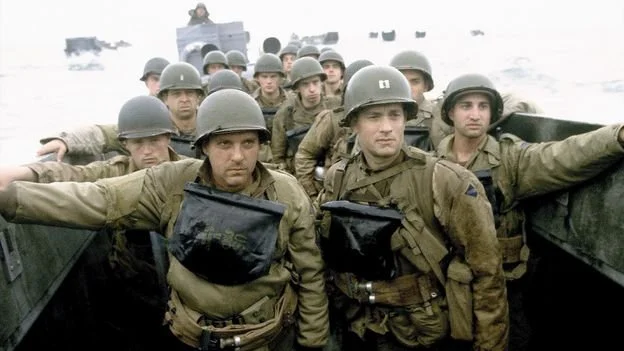
Saving Private Ryan (1998)
A Brief History of Film
Part Twelve: The Cynical 90s, a New Sincerity, CGI, and More
by Fr. John Wykes, OMV
He was standing on the beach. And he was sincerely moved. Almost to tears.
NBC News Anchor Tom Brokaw was covering the 40th Anniversary of D-Day. Visiting Normandy while aging World War II vets recounted their horrors, Brokaw was overwhelmed. “I realized how much we owe them,” the anchor said. Years later, in 1998, he wrote The Greatest Generation.
Baby boomers who had patted themselves on the back for student uprisings in the ‘60s and Vietnam War protests in the ‘70s had become somewhat cynical by the time the ‘90s rolled around. They felt they had seen just about everything – and had been lied to incessantly. Their generation had fought in Vietnam under horrendous conditions and were greeted with disdain when they came home. In their view, the older generation had been embraced after having fought a World War that seemed tame by comparison, then lived a comfortable life of prosperity and security.
Talking with the greatest generation dispelled this erroneous paradigm. And Hollywood took note.
It started in the late 80s, with whispers that Steven Spielberg was about to get serious, especially about a book entitled Schindler’s Ark. Many in the industry scoffed at the idea of a sci-fi/adventure movie maker taking on a Holocaust film. Even Spielberg had doubts – talking to many other directors before finally deciding to helm the picture himself.
Famous film composer and long-time Spielberg collaborator John Williams was overwhelmed by the rough cut of Schindler’s List (1993). He said nothing at first – opting to take a walk outside. Upon his return, Williams approached Spielberg and said, “I honestly don’t know if I can do this score. I think you need a better composer.”
“I know I do,” Spielberg answered, “but they’re all dead.”
Schindler’s List was released in 1993 to a stunned and impressed movie-going audience. It ended up winning several Academy Awards, including two for Spielberg (Best Director and Best Picture) and one for Williams (Best Original Score).
Spielberg followed up this achievement with a more direct salute to the Greatest Generation. Saving Private Ryan (1998) was praised by vets for its realism – some who had participated in D-Day felt they were re-living the event during the film’s traumatic opening scene. And Spielberg won his second Best Director Oscar.
Computer Generated Imagery (CGI for short) became the new rage. Often misunderstood as simply pressing a couple of buttons to create full effects sequences, CGI involves difficult and meticulous work. Creating a creature, for example, starts with “making” a skeleton, then adding muscle, then drawing skin over both, and then adding various features to the skin such as hair, wrinkles, and freckles. Once created, however, the “creature” can then be manipulated in various ways, with the muscles, bones, and skin all moving in coordination.
Modern CGI started way back in the early ‘80s with Disney’s groundbreaking TRON (1982). The primitive look became more refined with an often unappreciated but still impressive sequence from Star Trek II: The Wrath of Khan (1982) which offered Kirk and crew a simulation of the story’s “Genesis device.” Watching a dead moon come to life was part of film history, as the entire sequence was created in the computer. Toy Story (1995) was the first feature-length film created entirely with CGI. It impressed critics and made a lot of money.
The great acid test, however, came with Steven Spielberg’s Jurassic Park (1993), which proved beyond a doubt that CGI could make creatures realistic enough to interact with live action performers. From then on, effects houses such as Industrial Light and Magic had to make a dramatic shift from model-making to CGI.
The ‘80s and ‘90s also saw a renewed interest in international and independent cinema. The creative team of Merchant and Ivory turned out inexpensive but delightful art pieces such as The Bostonians (1984), A Room with a View (1985), Howards End (1992), and The Remains of the Day (1993). Poland’s Krzysztof Kieślowski created quite a stir with his now-classic films, including his Dekalog (1989) and The Three Colors Trilogy – Blue (1993), White (1994) and Red (1994). The “retomada” or re-birth of Brazilian cinema was best exemplified by Central Station (1998) while the Romanian New Wave was characterized by both realism and dark humor.
In Hollywood, a number of fine performances graced the silver screen, but the two most famous and versatile performers were Meryl Streep and Daniel Day-Lewis. Remarkable chameleons from one role to the next, both Streep and Day-Lewis were masters of their craft and won multiple Oscars.
Various new directors began to make their mark. Quentin Tarantino became famous for films of both great skill and intense violence. Joel and Ethan Coen created movies that mixed violence with humor. And Monty Python’s Terry Gilliam turned out fanciful films on a modest budget.
When James Cameron (The Abyss, Terminator, etc…) started working on a film about the Titanic, many scoffed at the cost overruns and investors got nervous. With the movie having a jaw-dropping $200 million budget and a potential running time of over three hours, memories of the disastrous Heaven’s Gate permeated the air. In the end, Cameron was victorious – beyond anyone’s expectations. Titanic (1997), even with its long running time, ended up earning over $2 billion and won a record-breaking eleven Academy Awards.
Walt Disney Studios, whose full-length, traditionally-drawn animations had waned during the ‘70s and early ‘80s, surprised just about everyone with The Little Mermaid (1989). It was a great success and the so-called “Disney Renaissance” was born – producing many notable hits such as Beauty and the Beast (1991), Aladdin (1992), and The Lion King (1994).
In Japan, animator Hayao Miyazaki relentlessly pushed himself and his Studio Ghibli staff to create some of the greatest animated films ever made. The ‘80s and ‘90s were known for such classics as Laputa: Castle in the Sky (1986), My Neighbor Totoro (1988), Kiki’s Delivery Service (1989), and Princess Mononoke (1997).
Back in California, George Lucas had waited several years for CGI to catch up to his dreams. In the late ‘90s, he was ready to work on his second Star Wars trilogy. Released in 1999, Star Wars Episode I – The Phantom Menace received mediocre reviews but created film history with the first Star Wars character created by CGI (“Jar Jar Binks”).
The long-term fall out was difficult for two of its stars. Jake Lloyd, whose performance as the young Anakin Skywalker had been lambasted by critics, was constantly bullied in school and developed schizophrenia later on. Out of anger and frustration, Lloyd destroyed all his Star Wars memorabilia.
The character of Jar Jar Binks was considered to be irritating; relentless mocking on the internet caused actor Ahmed Best to seriously consider suicide (thinking about his son prompted Best to step away from the bridge at the last moment). Both Lloyd and Best have made their peace with their parts in the franchise and have experienced a very positive reappraisal for Millennial fans who treasure Phantom Menace as a precious childhood memory.
Back in the late 1990s, during Phantom Menace production, reps from little-known Weta digital in New Zealand paid a visit, wanting to know more about how Jar Jar Binks was created. They thought this would be a help for their own project – the creation of Gollum for an ambitious Lord of the Rings trilogy of films. The first years of the 21st Century, with its triumphs and tragedies, will be the subject of our next article.
Note: After two weeks, this article will be archived under “A Brief History of Film” which can be located under “Articles, Essays, Blogs, and More” from the main menu.