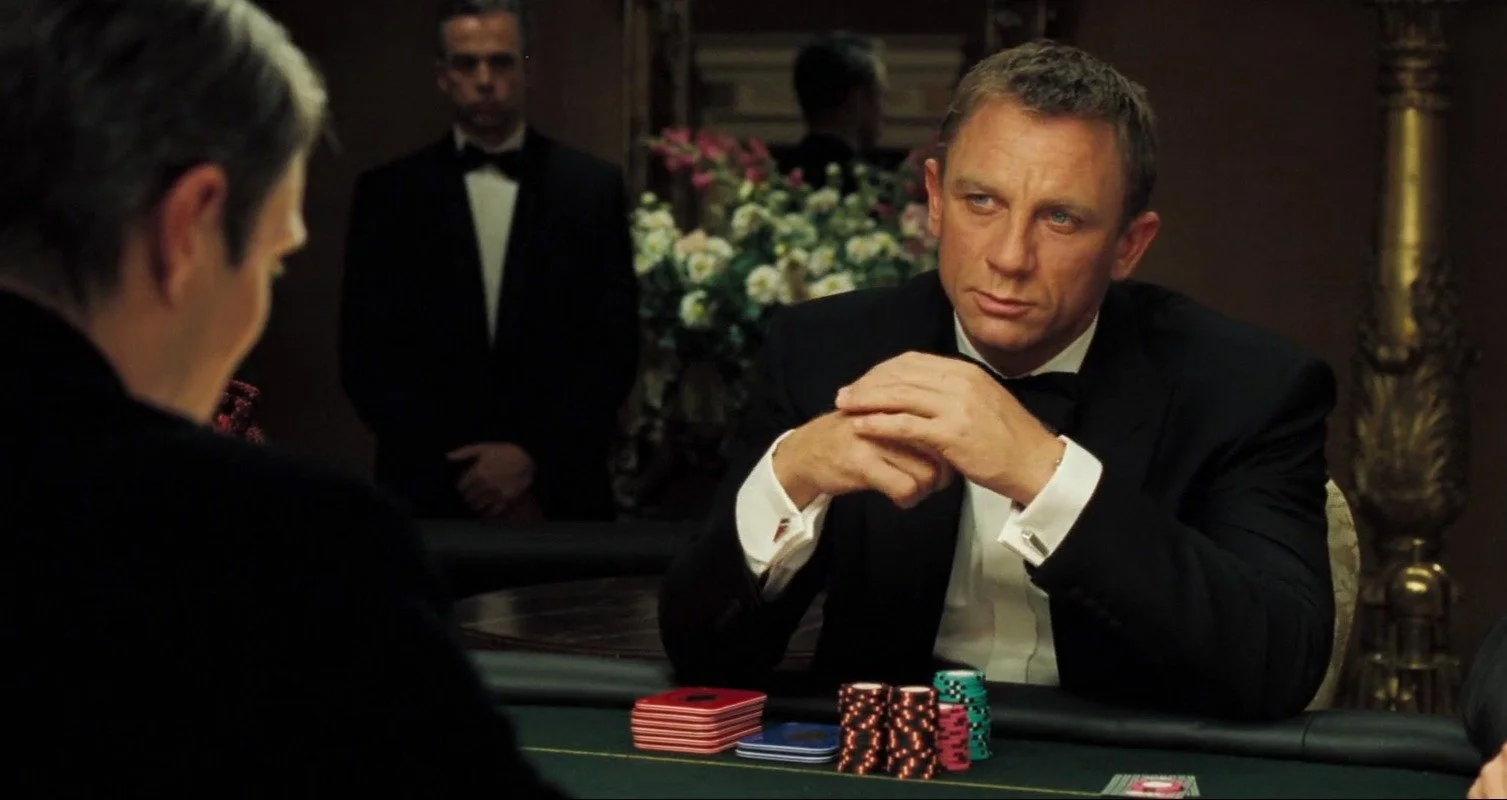
Just a game of Poker. Casino Royale (2006)
A Brief History of Film
Part Thirteen: Cinema Enters the 21st Century
by Fr. John Wykes, OMV
It’s an ordinary afternoon at the bank and employees are ready to leave for the day. Suddenly – an explosion! Noxious gas fills the air. Within seconds, armed men enter wearing face masks, rob the bank, and make a quick getaway by helicopter. It seems like the perfect heist, and the robbers pat each other on the back as the chopper dashes past the skyscrapers of Manhattan.
But wait – what’s this? The helicopter stops in midflight. How is this even possible? The robbers yell at each other in confusion. The camera pulls back to reveal the truth – the chopper has been snared in Spiderman’s web. And there it hangs, the helicopter that is going nowhere – dangling between the Twin Towers of the World Trade Center.
All well and good for this Spiderman trailer that was released in the summer of 2001. On September 11, everything changed. And the trailer was quickly yanked from theaters.
The horrifying 9/11 terrorist attacks shook the world to its core. The iconic Twin Towers were destroyed and nearly 3,000 people were murdered on live television.
The cynical ‘90s gave way to reassuring hugs between Manhattan stockbrokers and a strong resurgence of previously abandoned phrases like “God bless you” and “God bless America.” The self-congratulatory tech revolution, so proud of its personal computers and new internet capabilities, was now living in a world where the largest terrorist attack in history was accomplished by young men armed with nothing but box cutters and fake bombs.
Hollywood adjusted. It had to.
Spiderman (2002) was the most prominent of the films that had to be altered. The Sam Raimi film had been shot in early 2001 and featured at least a few glimpses of the Twin Towers. The Towers were digitally removed. The trailer was pulled and posters featuring reflections of the Twin Towers were changed. A delightful sequence was added to the final film in which the Green Goblin is thwarted by ordinary Americans who throw soda cans and other common objects at the villain (shadows of how ordinary Americans on the doomed Flight 93 fought to regain control of the plane from terrorists).
Perhaps in need of a greater adjustment (really a complete overhaul) was the James Bond franchise. The 1990s Pierce Brosnan pics had become increasingly high tech, culminating in 2002’s Die Another Day. Though popular, the movie was criticized for relying too much on CGI and for stretching the suspension of disbelief to the breaking point. The high-tech gadgets included brief references to every single gadget that appeared in previous Bond films as well as an invisible car which audiences deemed ridiculous. In a post-9/11 world, modern technology seemed almost meaningless. If one of the most powerful countries on earth couldn’t stop young men armed with box cutters, what could James Bond do with his 1990s gadgets and his silly invisible Aston Martin?
Not surprisingly, the franchise decided to return to its roots. And to tone down the gadgets to a minimum.
The first Daniel Craig 007 film was released in 2006 (Casino Royale). The centerpiece was not a high-tech, computerized chase but a dramatic and tautly-edited game of Poker. In Skyfall (2012), Bond meets a very youthful-looking Q, the new quartermaster. When Q presents Bond with two very low-key gadgets, Bond laments, “A gun and a radio. Not exactly Christmas, is it?" Q smiles and imparts the wisdom of a new post-9/11 world: “Were you expecting an exploding pen? We don’t really go in for that anymore.” Noteworthy is Skyfall’s concluding scene, which features Bond, M, and Kincade using ordinary household objects to defend themselves from imminent attack. “Sometimes,” says Kincade, placing a knife on the table, “the old ways are the best.”
Peter Jackson’s epic Lord of the Rings trilogy ran into very few post 9/11 adjustment problems, despite its release dates (the first film, The Fellowship of the Ring (2001), was released just three months after 9/11). The only serious question mark came with The Two Towers (2002) when it was suggested that the title reminded people of the Twin Towers. Peter Jackson and most die-hard Tolkien fans insisted on keeping the name, and won out, most especially since the title of the original book pre-dated 9/11 by almost fifty years. By the time of The Return of the King (2003), people knew they had an instant classic on their hands. All three films had featured beautiful direction and cinematography, great acting, outstanding production design, an epic music score, and life-like CGI that blended almost seamlessly with the live action footage. Oscar night of 2004 was a way to honor the entire trilogy, even though only the last film qualified for the golden statuettes that year. The Return of the King gobbled up a hefty eleven Academy Awards, including Best Visual Effects, Best Original Score, Best Art Direction, Best Director, and Best Picture.
In the meantime, George Lucas was busy working on the rest of his Star Wars prequels. For Star Wars Episode II: Attack of the Clones (2002), Lucas did something that went almost completely unnoticed at the time but nonetheless was a turning point in cinema – he shot all principal photography using digital video, NOT movie film. This radical and daring move was a downgrade of sorts – the equivalent of what we would call 2K (half the resolution of today’s 4K monitors) couldn’t compete with the crisp details of motion picture film. But it came close. Add to the equation professional lenses and a shooting speed of 24 frames per second (the same frame rate as film), and the final result was quite impressive, heralding an upcoming move to digital technology.
To be clear – CGI and digital technology had been around for quite some time. But even Lord of the Rings, with its extensive use of CGI and digital color grading, was shot on good, old fashioned movie film. So Lucas’ move with Episode II was truly revolutionary.
Speaking of digital – the DVD became the most quickly-adopted home video format ever created. Blockbuster destroyed its VHS inventory and quickly replaced it with shiny new DVD discs. The new format not only delivered a much better picture with true stereo sound, it also offered new concepts such as optional languages, audio commentary by the director and stars, and many extras such as interviews and behind-the-scenes documentaries. For general audiences, it made home cinemas more exciting. For serious film aficionados, the DVD was a dream come true and an indispensable tool for serious cinematic studies.
The new century saw the premiere of Memento (2000) the breakthrough film of thirty-year-old Christopher Nolan. The innovative film told the story of a man afflicted with short term memory loss. In an effort to bring the audience into this world, each scene was followed by a scene that happened “before” the previous scene. In other words, all the scenes were presented in reverse order. Meanwhile, black-and-white scenes depicting “present time” were interspersed with the reverse color scenes, only presented in normal forward progression. The result was strange, disturbing, and strangely hypnotic. Most especially, Nolan was reviving the fragmented timeline approach first presented by Orson Welles with his Citizen Kane (1941). Moviegoers were entranced. This marked a new stage of cinema. Much of 21st Century film would be experimenting with alternate timelines and parallel universes. The approach was so successful that it permeated many genres, everything from superhero movies to the Star Trek (2006) re-boot (the latter featured a so-called “Kelvin timeline”). Nolan himself followed up Memento with other similar mind-bending films, including The Dark Knight Trilogy (2005-2012), Inception (2010), and Interstellar (2014).
Wes Anderson, with his charming symmetrical compositions, offered audiences his quirky view of life in such films as Rushmore (1998), The Royal Tenenbaums (2001), and his award-winning The Grand Budapest Hotel (2014).
Meanwhile, actor/director Mel Gibson was quietly preparing a new project. A man of deep faith, Gibson wanted to make a film on the Passion of Jesus Christ. Even more noteworthy, he wanted to use the original languages (with the Romans speaking Latin and Jesus speaking Aramaic). Few people wanted to touch the project, and Gibson began filming without any outside funding. Distribution had not been secured, either. In a bizarre move, Gibson handled the marketing and distribution himself. As word got out about this project, more and more churches began to support the film, with many parishioners promising to fill the theaters during its Ash Wednesday 2004 opening. And they did. Ash Wednesday, the first week of Lent, and beyond.
The liberal Hollywood establishment, firmly entrenched since the 1960s, was aghast at the film’s popularity. They were faced with the prospect of their empire going up in flames. They wanted to attack the film, but how? The anti-Semitic criticism was firmly dismissed by critic Roger Ebert. Also, Gibson’s opus couldn’t be criticized for being too “saccharine” (the typical criticism leveled by progressive Hollywood against religious films) since it was clearly too intense for children and rated R.
After due consideration, Hollywood came up with the most bizarre and hypocritical statement in its entire history – The Passion of the Christ is a bad film because it’s too violent.
Yes, too violent.
This is the same Hollywood that gave us The Exorcist (green vomit, spinning head), The Godfather (dead horse head, murders by strangulation, shootings, etc.), Mean Streets (lots of fighting, shootings, gang fights), Taxi Driver (lots of profanity, violence, murder, final bloody shootout), and Scarface (shootings, final bloody shootout, and hacking a man to death with a chain saw), along with countless slasher and horror films. Even author Steven King, whose pen crucified children in The Children of the Corn and incinerated an entire gym full of teenagers in Carrie, had the audacity to write a commentary on the violence in Gibson’s new film, saying it was not healthy for children and mocking Christians who “like popcorn with their crucifixions.”
Despite almost hysterical criticism, The Passion of the Christ (2004) broke major box office records and outperformed all expectations. Made on a budget of $30 million, the film raked in an astonishing $612 million worldwide.
It was a bitter lesson for a secularized Hollywood used to calling the shots. Religious people wanted religious films and were tired of being mocked and ignored by the media elites. Thanks to affordable digital technology, more and more Christian independents, inspired by Gibson’s success, were inspired to get creative and make their own films. Christian independent filmmaking of the 21st Century was born. More on this in our next article.
Note: After two weeks, this article will be archived under “A Brief History of Film” which can be located under “Articles, Essays, Blogs, and More” from the main menu.